
A few weeks ago, while vacationing in New Orleans, I had the opportunity to visit the National World War II Museum. After going through the numerous exhibits, including a captivating 4D movie experience, I was transported back in time as I learned again how the war began, why it was fought and the profound sacrifices made by the “Greatest Generation” to secure the freedoms, liberties, and form of government we enjoy today. Reflecting on those sacrifices, I found myself feeling not only deeply appreciative but also increasingly protective of our republic and way of life.
In light of the recent U.S. election and the implications it holds for the future of our democracy, I began to question: How stable and resilient is democracy as a system of governance? To explore this, I turned to history, researching civilizations that once embraced democratic principles but later saw them unravel. By examining these examples, I hoped to gain insights into the strengths and vulnerabilities of democracy—lessons that could help me better understand the challenges facing the United States today.
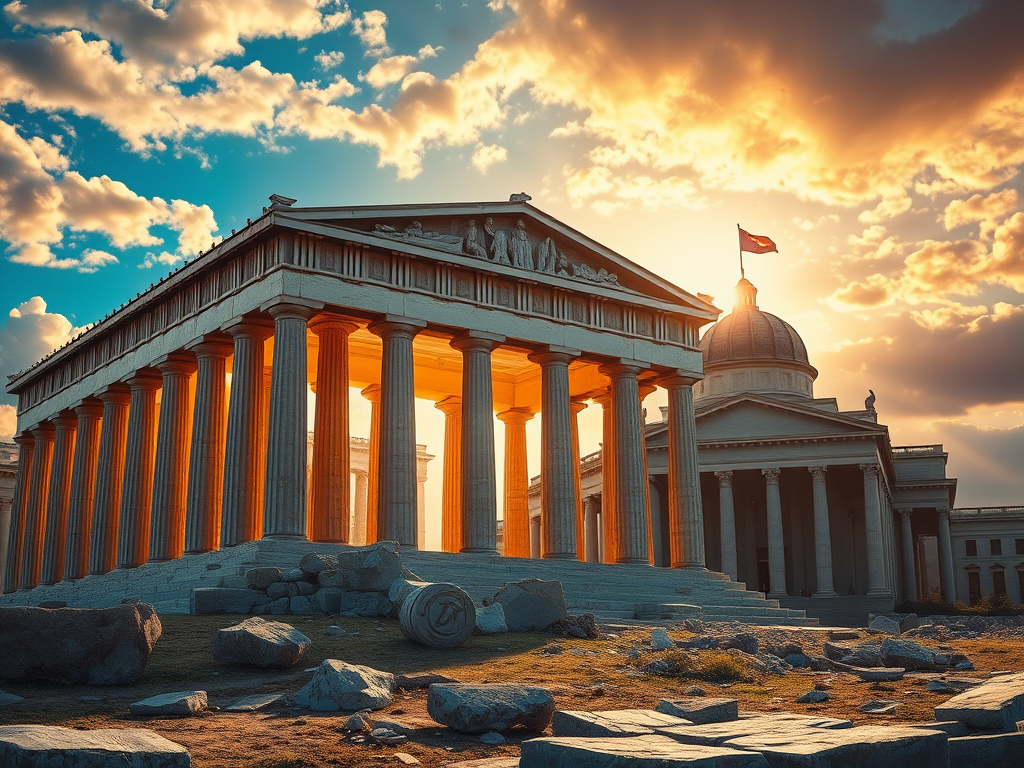
My exploration began with ancient Greece, as the Athenians are credited with inventing democracy in the 5th century BC. The core principle of this government was to empower the people which is reflected in the Greek word “Demokratia” meaning “power of the people.” Ancient Athens was the first civilization to practice democracy, and it endured for two centuries. While learning about ancient Greece was interesting, I wanted to find a more recent example to better understand the challenges and resilience of a democratic system. What I discovered next was both thought-provoking and unexpected since my findings related to the museum I had just visited.
After World War I, the German Empire—which was governed by a monarchy from 1871 to 1918—was dissolved. In its place, the Weimar Republic emerged as Germany’s first experiment with a fully democratic government. The Weimar Constitution introduced a parliamentary democracy with universal voting rights for all citizens over the age of 20, including women, making Germany one of the first major nations to extend voting rights to women. It also implemented a proportional representation system, allowing a diverse range of political parties to have a voice in governance. Under this system, Germany experienced several tangible benefits:
- Although short-lived the mid-1920’s saw a period of relative prosperity, industrial growth, and international cooperation.
- Women’s rights and social reforms advanced, creating a more equitable society.
- Progressive labor laws were enacted, including an eight-hour workday and better protection for workers.
- Germany was admitted to the league of nations in 1926.
OK, so if everything was going so well, what happened?
Although the newly formed government achieved notable progress, several factors after 1929 severely undermined its ability to sustain a government rooted in democratic principles:
- Germany’s economy was heavily dependent on foreign loans and investments, leaving it particularly vulnerable to the global economic collapse during the Great Depression.
- Due to the financial crisis that occurred after 1929, unemployment soared and social unrest grew, eroding public trust in democratic institutions.
- Proportional representation led to a fractured parliament with numerous small parties, making it difficult to form stable coalitions. This enabled extremist parties, like the Nazis to gain traction by exploiting economic and social grievances.
- The Weimer Constitution allowed the president to rule by decree in emergencies, bypassing parliament. This provision was abused and paved the way for authoritarianism.
- Many Germans disillusioned and suffering under economic hardship, turned to populist leaders like Adolf Hitler, who promised to restore national pride and stability.
Once Hitler and the Nazi Party seized power, democracy in Germany was dismantled from within, and became an Authoritarian nation. Witnessing the breakdown of democracy in Germany during this time led me to a compelling question: Why did the United States, which also suffered from the Great Depression, not succumb to populism in 1929 as Germany had?
As I delved deeper into this question, the answer became clear.
The United States also endured significant economic and social hardships during the Great Depression (1929–1939). However, rather than turning to a populist or authoritarian leader, Americans elected Franklin D. Roosevelt, who introduced transformative policies through the New Deal. Several key factors explain why the U.S. resisted the pull toward populist or authoritarian solutions during this period:
- Americans at that time were deeply rooted and committed to the US constitution and democratic governance. They honored the separation of power that creates a system of check and balances and were very skeptical of centralized power making it difficult for extremist ideologies to gain traction.
- There was public faith in the voting system which reinforced that their vote counted and could illicit change.
- FDR was a charismatic leader who spoke directly to the people. He focused on progressive reforms, like social security, unemployment insurance, and public works programs to address economic challenges rather than Authoritarian rule.
- In the 1930’s the US had a relatively independent press that played a critical role in holding leaders accountable and informing the public in one consistent voice.
Conclusion
After examining these lessons from history, it is clear that we, as Americans, are at a critical crossroads in our journey as a democratic nation. Much has changed since the 1930s, presenting new challenges that test our ability to preserve democracy. The advancement of technology and the rise of social media have enabled the rapid spread of false and manipulated information, eroding public trust in government institutions and the free press. Many Americans now obtain their news from unreliable sources, fostering a misinformed society and leaving many to wonder, what is the truth? Meanwhile, persistent income inequality has widened the gap between the rich and the poor, hollowing out the middle class and deepening social divides. Efforts to restrict voting access, gerrymandering, and growing skepticism about the electoral process have further undermined confidence in the integrity of our elections.
To safeguard our democracy I must admit will not be easy and it will take a village. It’s imperative that we strengthen our institutions not dismantle them. Addressing economic inequality, promoting media literacy, and investing in civic education and engagement are critical steps toward restoring trust and fostering informed citizenship. Equally important is the need to bridge political divides, reduce polarization, and renew faith in the democratic process.
I encourage my fellow Americans to become students of history, to visit places like the National World War II Museum, and to reflect on the sacrifices made by the “Greatest Generation” to confront tyranny and protect liberty. Their legacy reminds us of the fragility and value of democracy. By learning from the past—particularly from Germany’s failure to defend its own democracy—we can avoid repeating its mistakes. As the saying goes, “Those who cannot remember the past are then condemned to repeat it.”
 Lisa VanPatten
Leave a comment